About MSCA Doctoral Network RESCUE
Across Europe, legacy and emerging contaminations continue to threaten soil and groundwater resources, degrading ecosystem services, reducing land value, and posing risks to human health. With nearly 2.8 million potentially contaminated sites, the scale of the challenge is striking. The recently adopted EU Directive on Soil Monitoring and Resilience sets the goal of achieving healthy soils across the EU by 2050. Conventional remediation practices remain challenged by the complexity and inherent uncertainty of characterising and monitoring subsurface properties and processes, and evaluating remediation performance. Europe faces a shortage of researchers and practitioners trained to apply emerging, cross-disciplinary approaches to sustainable remediation.
The Marie Skłodowska-Curie Actions (MSCA) Doctoral Network (DN) RESCUE is designed to equip doctoral candidates with the skills to integrate non-invasive geophysical methods with advanced remediation technologies responds to this need. By bridging environmental engineering with geophysics, RESCUE will strengthen Europe’s capacity to address soil and groundwater pollution challenges through more effective, efficient, and environmentally responsible solutions. Following a value-chain framework, RESCUE spans from fundamental understanding of coupled biogeochemical-geophysical processes, through high-resolution site characterisation and monitoring and optimisation of active (bio)remediation, to evaluating the socio-economic viability, sustainability and legal aspects of geophysics-informed sustainable remediation.
RESCUE will drive a paradigm shift in training and practice, promoting integrated and sustainable management of soil and groundwater resources. RESCUE will train a new generation of scientists to become highly employable professionals within environmental and engineering companies, public agencies, and academic and research organizations, while establishing a sustainable training network for both academic and professional communities.
Research and training programme
RESCUE – Remediation Enhanced by Subsurface Characterisation & monitoring Using geophysical Evaluation – addresses key challenges in geophysics-informed sustainable remediation by integrating complementary geophysical methods across laboratory, pilot, site, and landscape scales for a broad range of contaminant types and remediation contexts.
To structure these activities, RESCUE is organised into four interconnected research work packages (WPs):
- WP1 focuses on understanding contaminant behaviour and associated geophysical signatures under controlled laboratory conditions.
- WP2 develops uncertainty-aware geophysical methods for high-resolution site characterisation and conceptual site model development across site and landscape scales.
- WP3 addresses the monitoring and optimisation of contamination and remediation processes at pilot and field scale, including bioremediation and electrochemical remediation strategies.
- WP4 evaluates the socio-economic, environmental, sustainability and legal aspects of geophysics-informed remediation approaches.
These research activities are supported by dedicated work packages on training (WP5), dissemination and outreach (WP6), and project management (WP7).
As a Horizon Europe MSCA Doctoral Network, RESCUE combines cutting-edge research with interdisciplinary doctoral training and intersectoral exchange.
The network will train doctoral candidates through an integrated programme of local and network-wide training and research activities, including collaborative PhD projects and international and intersectoral mobility and exchange across academia, industry, public authorities, and other societal stakeholders. Training activities cover both scientific and technical expertise and transferable skills, including communication, project management, entrepreneurship, open science, and stakeholder engagement.
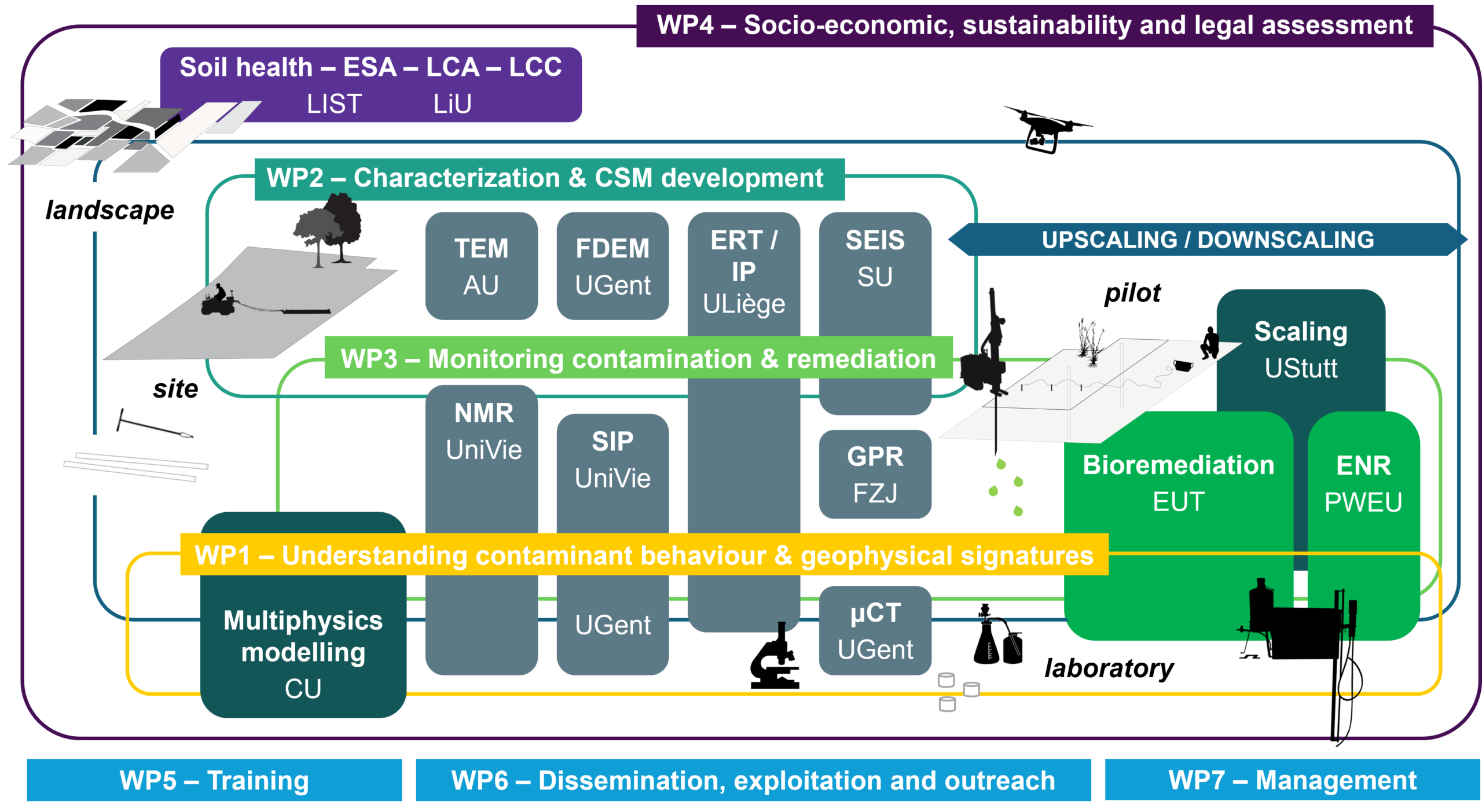
Method abbreviations: ERT = electrical resistivity tomography; (S)IP = (spectral) induced polarization; FDEM/TEM = frequency-/time-domain electromagnetics; GPR = ground penetrating radar; NMR = nuclear magnetic resonance; ESA = ecosystem services assessment; LCA = life cycle assessment; LCC = life cycle costing.
Beneficiary abbreviations: UGent = Ghent University; ULiège = University of Liège; SU = Sorbonne University; FZJ = Forschungszentrum Jülich; UStutt = University of Stuttgart; AU = Aarhus University; UniVie = University of Vienna; EUT = Eurecat; LiU = Linköping University; CU = Cranfield University; LIST = Luxembourg Institute of Science and Technology; PWEU = Photon Water Technology.